



Table of contents:
- What is Idea Generation?
- Different ways to look for ideas for ventures.
- Proprietary Ideas. How to find inspiration for ventures?
- How to create ideas?
- Corporate Ideas. How to use your internal brainpower?
- External Ideas. How to invite external brainpower?
- How can partnering with Corporate Venture Builder boost idea generation
Hi Innovators!
As the person in charge of sourcing venture ideas here at The Heart, I've seen firsthand how critical it is to have a solid ideation process in place.
After all, coming up with great ideas is the foundation of any successful innovation effort. But ideation isn't just about brainstorming sessions and hoping for the best. It's a structured process that involves everything from understanding customer needs to exploring new technologies and industry trends.
The ideation process is divided into two main parts:
- Idea Generation - How to look for ideas for ventures?
- Idea Assessment - How to assess if the idea is good?
In this article, I will cover the idea generation part and will mainly focus on the framework of creating your own ideas from a corporate perspective. I want to share some of my top tips for successful ideation that will help you and your team generate and develop ideas that can truly make a difference. The Idea Assessment part will be shared in the next few weeks.
Anyway, let's dive in and start ideating!
What is Idea Generation?
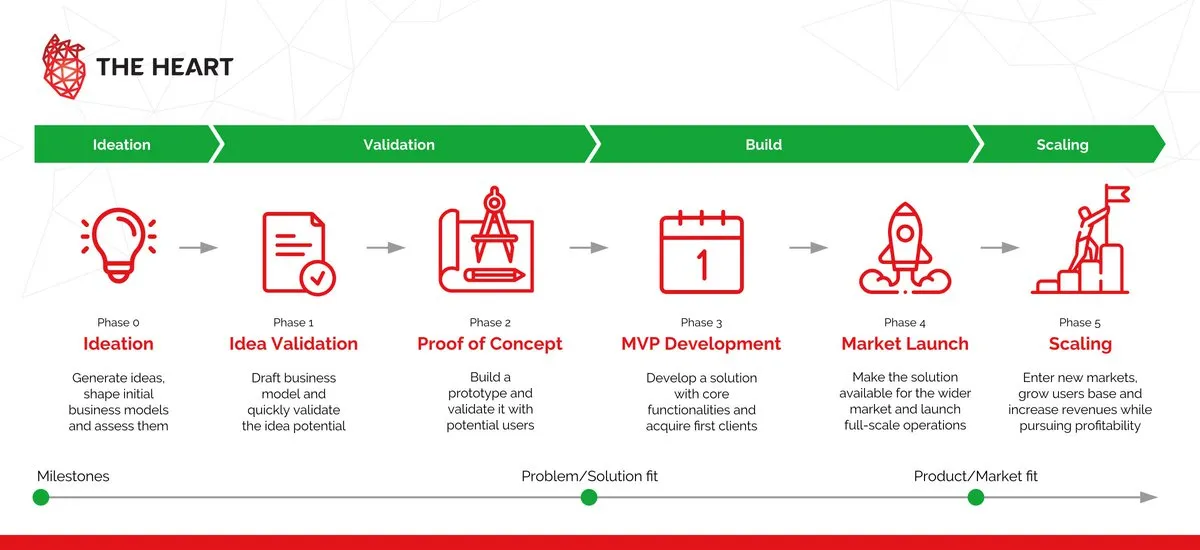
Simply put, an Idea Generation is a part of the ideation process that aims to discover and develop new ideas that may become successful ventures in the future. It is the very first stage of the whole venture-building process, where ideas are generated, before being assessed and selected for the validation phase.
The whole venture building process is illustrated below:
Different ways to look for ideas for ventures
There are 3 sources of ideas for corporate innovation units:
- Proprietary ideas - ideas that are discovered by a corporate innovation unit team.
- Corporate ideas - ideas that are organically created within the company, outside a corporate innovation unit.
- External ideas - ideas brought by independent founders, already existing startups or other established companies.
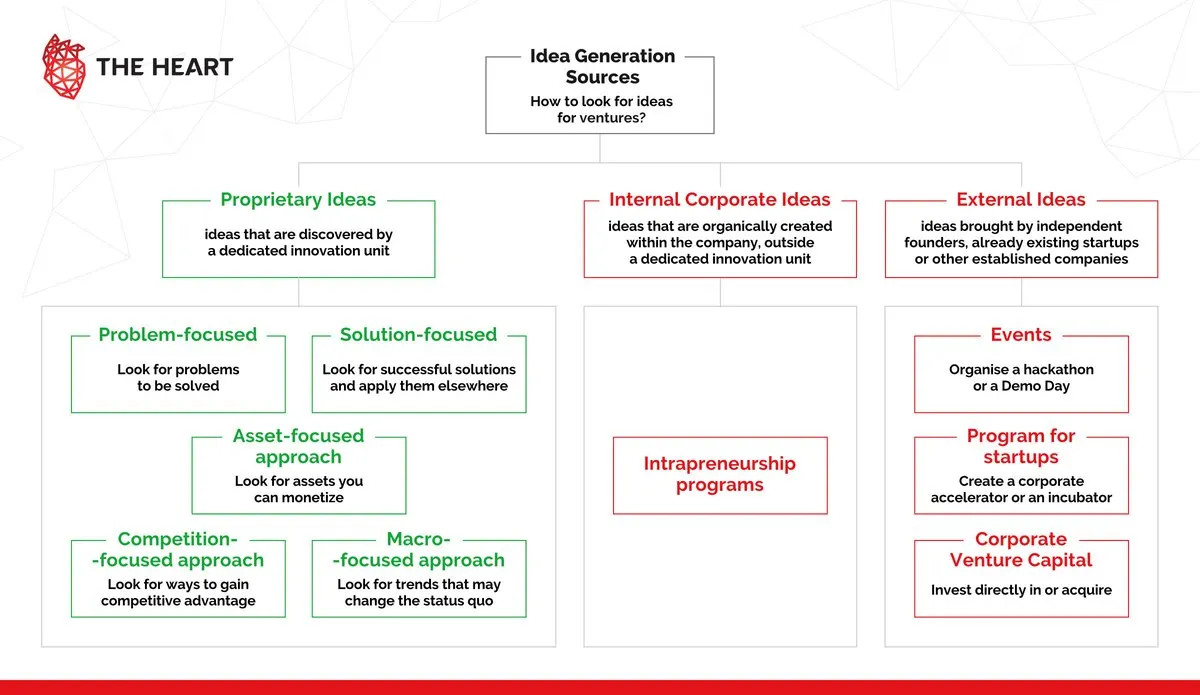
Proprietary Ideas - 5 main paths that you can follow
Those are the ideas that were created within a corporate innovation unit through active searching and creative workshops.
1. Problem-focused approach - How do I solve the pain points of my stakeholders?
In this approach, you start by identifying problems that are worth solving. You can do this by:
- Looking outside your company - organize meetings with clients, users, partners, competitors and discuss their challenges.
Example:
We founded Digital Gateways with Mastercard while looking for an online verification solution for banks. We have discovered that the current alternatives are not suited for the banking environment and decided to create one.
- Looking inside your company - create a list of challenges that the company faces or faced in the past that may be relevant for other companies.
Example:
Coca-Cola created an on-demand staffing platform Wonolo to solve its internal problem with blue-collar employees recruitment and scaled it through its clients and partners who experienced similar challenges.
2. Solution-focused approach - How can I re-apply existing solutions?
In this approach, you start by looking for existing business models and solutions. In general, there are 3 ways of leveraging existing business models:
- Geographical arbitrage - Look for successful companies from different markets that are not present in your market.
Example:
Żabka explored autonomous store solutions from other countries and created its own Żabka Nano concept.
Example:
Orange built Flex, a simple, transparent, fully-digital mobile service provider in D2C model, uncommon for mobile network operators, possibly being inspired by a wave of fully-digital and mobile challenger banks.
- Business model arbitrage - Look for an existing product/service/process that is successful in X vertical but is not yet present in Y.
Example:
Santander built PagoFX that focused only on a part of all services offered by the bank - foreign exchange payments, to better compete with other alternatives in this field.
The easiest way to find the most recent successful solutions and business models is to track startup investment rounds through innovation-related media, startup databases, or by looking at early-stage investors' portfolios. You can also do scouting projects focused on a given industry to have more in-depth intelligence.
3. Asset-focused approach - How can I monetize our assets?
Focus on what your company is good at. List your assets like know-how, IP, products, and project portfolio to see what you can take advantage of.
Example:
AWS was built by Amazon to monetize its cloud infrastructure.
4. Competition-focused approach - How can I gain or protect our competitive advantage?
Map your customer journey and value chain, then put your competition and current offering on it. Select gaps that you wish to fill. Try to also think about value-added services around the core product that can enhance the value proposition. My favourite way to do that is by using Blue Ocean Strategy Canvas.
Example:
Vipps, a leading payment solution in Scandinavia was built by DNB, as its competitors were launching similar products in the space like mCASH by Sparebank or MobilePay by Nordea.
5. Macro-focused approach - How can I benefit from macroeconomic changes?
In this forward-thinking approach, you must identify shifts in customers’ behaviour, emerging technologies, regulatory changes, and other macroeconomic trends that may change the current market conditions. You can use the PESTLE analysis framework to note the relevant trends in your industry. You can identify trends by scouting projects, reading market reports and research papers, or participating in industry events.
Example:
ShareNow, a car rental service with no rental offices or return stations, was built by Daimler to leverage the trend of sharing economy and growing preference for renting instead of owning.
How to create ideas?
Once you have prepared a list of inspiration, you can commence the ideation process. I recommend using a design thinking framework. There are various ways to boost creativity and ideate, and I'll not cover them in this article but here is a general example:
- start with listing all the inspiration you found from the paths above,
- prioritize them and select the most important ones,
- mix them by starting from the prioritized ones - you can use the following structure: what if we build [solution] to solve [problem for target customer] and gain [competitive advantage] using [our asset] and leveraging [macro trend]?
Example:
AIS Gateway for Digital Gateways - what if we build an AIS provider to solve online financial verification inaccuracy for financial services and gain an extended product portfolio using Mastercard as a technology partner and leveraging e-commerce market growth?
Useful tips:
- Start your challenge definition with the phrases like: “How might we…” or “Wouldn’t it be great if…”. They are great openers to a creative discussion!
- The clash of domains is good - invite people from different units as the more different perspectives and knowledge, the greater the idea pool.
- Change collaborators - try to invite new people to the ideation process. Each person has a unique mind and background, which increases the chances of coming up with ideas that were not mentioned before.
- Be aware of the "creative cliff illusion" as the best ideas don't necessarily come up first - creativity does not decline significantly with time.
- Mashup ideas - after you generate the first batch of ideas try to combine them together.
- Think through analogies - e.g. a hospital ER room wanted to be more efficient and they succeeded by thinking of F1 pit crew and dividing the room into sections responsible and for only one function.
Corporate Ideas. How to use your internal brainpower?
Ideas can also be organically created within the company, outside a corporate innovation unit. However, a drastic shift in organizational culture and innovation framework is often required to boost the inflow of ideas from other traditional business units.
A process of collecting and developing internal ideas must be created, providing clear instructions and incentives for employees to submit an idea or product that may be commercialized. The corporate innovation unit may also consider launching an intrapreneurship program where employees may devote some of their time to work on their ideas.
Example: IBM developed Watson, an artificial intelligence platform, as an internal research project. The platform has since been offered to external customers in a variety of industries, including healthcare, finance, and retail.
If a company fails to provide a path for intrapreneurs and the right incentives, it may end up with employees leaving and starting businesses externally like in the case of Jack Dorsey.
While working at Twitter, Dorsey experienced difficulty in accepting credit card payments for merchandise sold on the platform. He left Twitter to start Square, a mobile payment processing company that enables small businesses to accept credit card payments, reaching a $40B market capitalization.
External Ideas. How to invite external brainpower?
Following the open innovation paradigm, a company should not limit itself to internal ideas and should consider the ones that may come from external sources, like startups, universities, or other established companies.
The benefit of focusing on external ideas is that they may come at later stages and it is easier to find them than create one.
However, you are not the owner of the IP rights and there is a risk that an existing solution you are looking for will be not fully adjusted to your needs.
A corporate innovation unit has a wide range of corporate venturing mechanisms to attract and find ideas at different stages of development:
- Events - one of the easiest and less capital-intensive methods is to organize an event in which innovators, startups, and scientists can participate. The two most popular ones are:
- hackathons during which participants try to solve chosen corporate challenges
- competitions where startups submit their ideas and chosen ones present them on Demo Day, after which a winner gets a prize, which usually is in a form of cash and/or pilot
Example: Comfy, a workplace experience platform that helps employees optimize their workspaces for comfort and productivity, went through the accelerator program led by Siemens. Later on, Siemens acquired Comfy and integrated them into their offering for buildings.
- Corporate Venture Capital - a company may directly invest in or acquire startups that fit their strategy. Setting up corporate venture capital would attract more startups and make the process more efficient.
Example:
E.g. Pracuj.pl set up Pracuj Ventures and invested in companies from related industries such as SeniorApp, Worksmile or Beamery.
If you want to learn more about the corporate venturing mechanisms you can check out the research papers prepared by IESE.
How can partnering with Corporate Venture Builder boost idea generation?
Generating ideas is a challenging process and it is very hard to make it efficient if it is done internally. A professional partner that is specialized in finding venture ideas is a valuable asset for the corporate innovation unit.
Corporate Venture Builder can improve idea generation process and increase the number of high-quality business ideas thanks to:
- additional know-how and multi-domain expertise, especially in new technology and startup ecosystem
- dedicated process and resources assigned to perform idea generation tasks
- extended business network and access to the local startup ecosystem
Here you can find some examples of services provided by Corporate Venture Builders and other innovation-focused companies that can support corporations with idea generation:
- Design thinking workshops facilitated by external expert
- Scouting projects - tailor-made reports covering a selected market with shortlist of interesting solutions, technologies, startups, business models, or relevant trends
- Events around innovation like ImpactCEE, Masters & Robots or The Heart Corporate Club (contact me if you want to subscribe!), where you can chat with representatives of other innovative companies and catch up with the latest trends.
You already know when it is worth considering CVB (and here is the link to the previous issue), we described the internal generation of ideas and in the next episode I will tell you how to assess and select the best ideas. Stay tuned!
If you want to learn more about Idea Generation, check the links below:
The guide by Y Combinator
The guide by Antler
The guide by Fabrice Grinda (FJ Labs)
The guide by Jeremy Utley - Stanford d.school
The guide on Corporate Venturing by IESE Business School
with The Heart?
Join us and be part of a team that's shaping the future through innovation, creativity, and bold ventures. Ready to make your mark?