



Table of contents:
- Why is Idea Validation an important part of the Corporate Venture Building Process?
- Idea Validation Process:
- Step 1: Make a business model assumption
- Step 2: Form your hypothesis in 4 categories
- Step 3: Test your hypotheses
- Step 4: Make adjustments and repeat
- Role of Corporate Venture Builder in validating business ideas
- What's next?
Why is Idea Validation an important part of the Corporate Venture Building process?
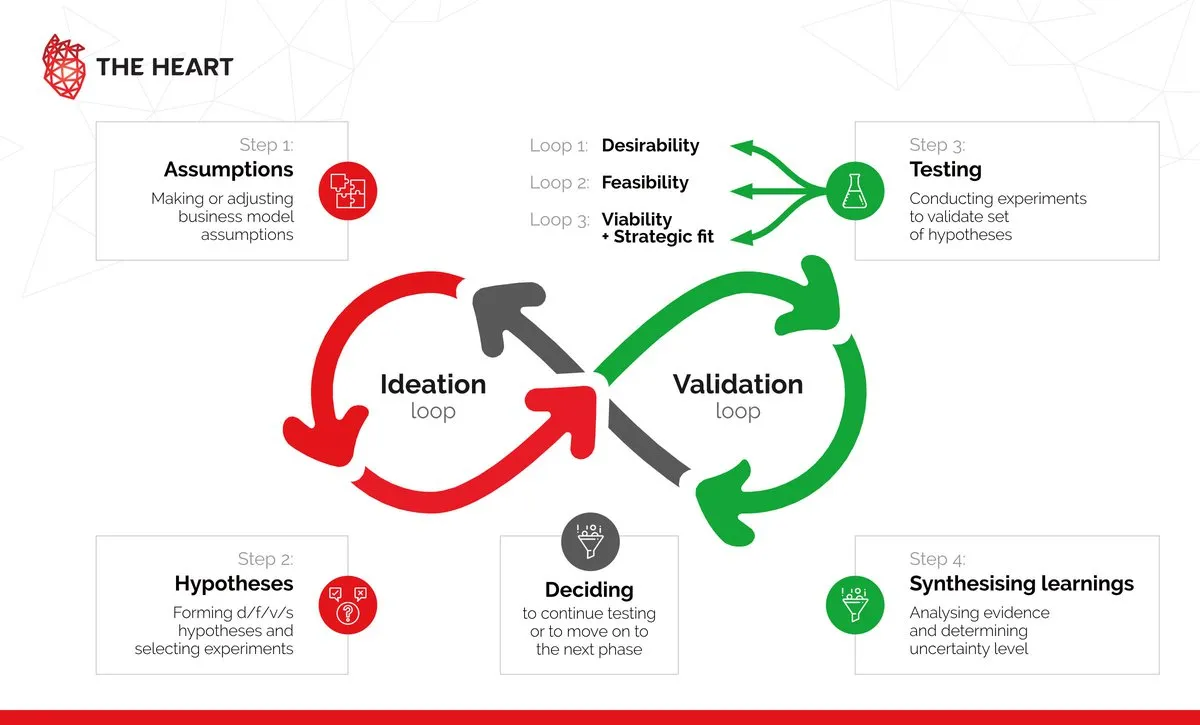
As Idea Validation Leader, my main task is to guide our teams in developing a solid set of assumptions for new business ideas and refining hypotheses for key risk areas.
In this episode of our Corporate Venture Building Guide, I want to walk you through our process where we conduct research and experiments to test and validate these hypotheses. By doing this, we can either move forward with our initial idea or make adjustments based on what we have learned from each experiment.
The whole point of Idea Validation is to gradually reduce the risk and uncertainty of what will later become a business. It's an important process that allows our teams to explore areas where new ventures are going to operate and provides evidence for us and our partners to make informed decisions for the future.
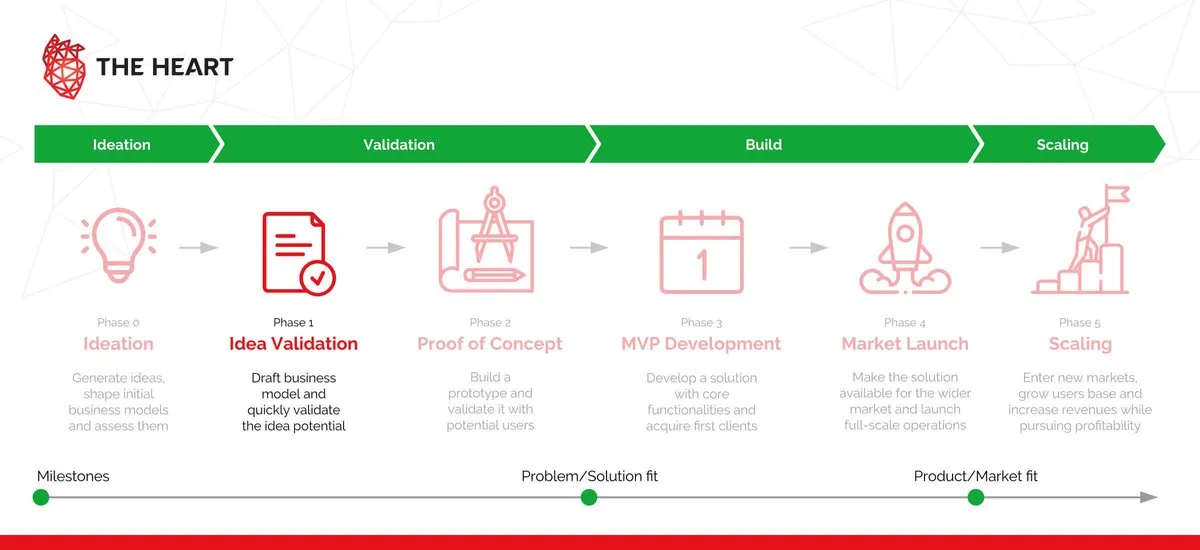
You can find the whole Corporate Venture Building process below. If you want to refresh your knowledge about the previous phase, read the articles about Idea Generation and Idea Assessment.
Idea Validation Process
With The Heart's 4-step method to validate a venture idea, you will explore the space in which you will have to market the product. You'll also get to know your customers better as well as learn about the market, competitors and get many other insights that will help you shape the ultimate business model for your initial idea.
Step 1: Make a business model assumption
To visualise business idea by making assumptions, we recommend using the Business Model Canvas from Strategyzer. It is a proven and regularly updated framework with many online resources available, so any team member can familiarize themselves with how it works.
At The Heart, we use different frameworks as well, depending on the type of business idea, the product development stage, the scope of the project, and the client's expertise and available resources. However, we find the Business Model Canvas (BMC) as most useful for solution ideas that need to be turned into working, profitable businesses, especially in the B2B or B2B2C space.
Best practices in making business model assumptions:
- Do a preliminary research
Coming up with an idea for a new venture, you rarely begin with a blank page and often develop a sort of affection for your initial idea. Perhaps you have the insight that some potential customers really need a solution for an important challenge or you have an asset eg. existing technology, that you want to commercialize or scale. This is why it is important to examine the market, existing alternatives, and try to understand major potential customers' problems on a high level. It will save you time to work on something that already exists and is well adopted, but because you are not a target customer, you just have never heard of it. - Don’t be too creative with possibilities of “what your idea might be/do in X years period, if you do this and that”
In that phase, you are working on a first idea that will be adjusted after you discover more and more facts. So make the first business model idea close to what you already know, ideally based on evidence. Eventually you will not know exactly how your customers will interact with the product until you build and launch a MVP. So rather than guessing, make informed decisions. - Invite experts
If you have access to the network of experts and practitioners that are willing to share their knowledge about existing processes and problems of potential users, it will be easier to form better assumptions that has greater chance to turn out to be true. At The Heart we are taking advantage of our network of corporate partners to ideate on potential business model ideas. Usually those experts later stay close to the project, validating product ideas and are also likely to become first customers if we proceed with development and launch.
Step 2: Form your hypothesis in 4 categories
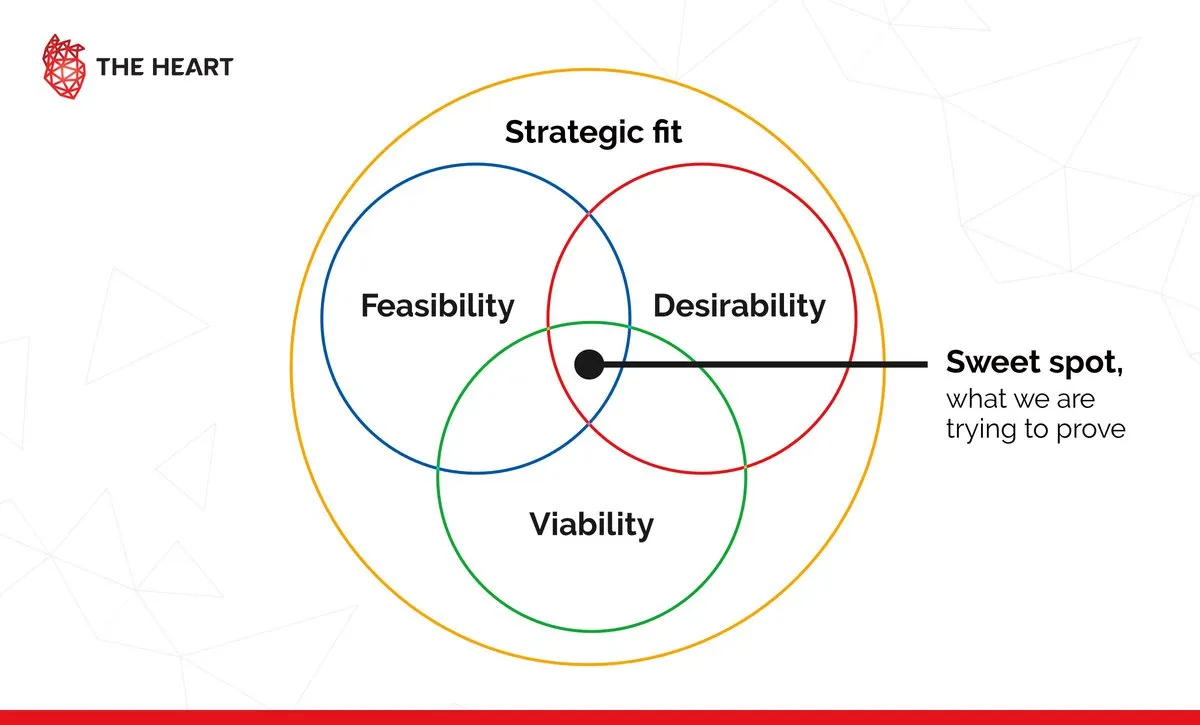
You are familiar with these categories because we are using it for the initial assessment in our Idea Assessment Framework.
- Desirability - answering the question “do customers want it?” It is important especially for B2B ideas when you might not know the end user of your product very well in the begining.
- Feasibility - if you proved that customers want it, are you capable of delivering it? What resources and activities does it take? Do you have the right talent on board to develop and market the product?
- Viability (or profitability) - finally you need find out what’s it worth, meaning is there a clear business case behind the idea? Can you put a price tag on your value proposition, maintaining the profitable business when considering all the costs related with delivering that value?
- Strategic fit - for the Corporate Venture Building ideas, we recommend to also consider a “strategic fit” category, which will provide evidence if your idea is in line with your company’s strategic objectives and resources
This way you will know:
a) if you are capable of executing the business idea using internal resources, and
b) even if the idea is not resonating well with the market, maybe you will find the business case inside your organization.These are fairly easy to validate by ideating in the group of executives and decision makers inside your organization and providing calculations based on your internal data.
It is important to mention that creating good hypotheses is a time consuming and difficult process, that you will master with time. To run a successful experiments and clearly define if assumptions are true, hypothesis must be:
- Precise - precisely defines variables and expected outcomes
- Testable - can be validated through observation, experimentation, or data analysis
- Discrete - focused and well-defined, that isolates a specific aspect
Here are some examples of hypothesis we tested on different projects:
- Blockchain technology will not be applicable because ecosystem participants use data from their internal systems as a source of truth and settlements basis
- By implementing the functionality we can increase active customers’ engagement in app by 20% in 1 month
- For purchasing managers, the financial liquidity gap is identified as one of top 3 problems
- By requiring the photo evidence of damaged euro pallets, our solution will shorten the time of discussion about pallets quality by 50%
- Blue collar workers rarely prepare a CV so a simple form when registering to the platform is necessary for seamless onboarding
Step 3: Test your hypotheses
There are different interpretations of the term "hypothesis," but in my view, the definition that best captures its essence in our context is: "A hypothesis is an assumption that can be tested." Therefore, it is important to make them precise and discrete to get the most out of the testing process.
We recommend starting by validating the desirability hypotheses, as it is the fastest and easiest way to determine if the parts of your business model that are responsible for providing value to customers are true. If you invalidate some of the hypotheses here, the recommended next step would be to revise your value proposition or customers you are aiming to acquire. Perhaps by targeting a different segment or capturing value in a different way, the idea has a better chance of success.
The experiments we use most often to validate desirability hypothesis are:
- Customer interviews.
- Existing alternatives analysis - by eg. reading the product reviews, looking for pain points.
- Competitors research - to help you find the Unique Value Proposition.
- Landing pages presenting your solution - we usually not do it in the first place because you need cleared product idea and communication that is understandable by your target customers, but for more defragmented markets where you don’t have direct access to potential customers it might be the most effective way of desirability validation.
- Mock-ups shown to potential customers.
With the satisfactory level confidence that customers might be interested in the solution, you can proceed to ideating on how the product might look like, which leads to creating a complete set of feasibility hypotheses, that can be tested using following methods:
- Technical feasibility.
- Consultations with tech experts - for example we use the support of our software house, The Heart R&D Lab, for technical feasibility consultations as well as during product ideation phase.
- Interviews with identified potential partners and suppliers.
- User stories - functional and nonfunctional requirements check.
- Legal feasibility.
- Legal consultations, we usually do it with experts from TH Legal, our boutique law firm, or legal professionals from our network.
- Legal consultations, we usually do it with experts from TH Legal, our boutique law firm, or legal professionals from our network.
- Operational feasibility.
- Competitors teams research to identify key personnel and specific talent that need to be hired.
Finally, you can proceed with testing the viability of business model. This means assessing the market capacity, revenue generation potential, key costs that must be incurred to maintain such business, and scalability, to determine the potential for long-term commercial success. Some proven methods to test business model viability are:
- “Sales pitch” to potential customers concluded with signing LOI - I recommend proceeding with LOIs while testing B2B ideas. It is a non binding document, but lack of will from your potential customer to sign even that may shows that A) they are not really interested in purchasing product in the future or B) maybe they are not a decision makers in their organisation.
- Financial modeling, reflecting validated desirability and feasibility assumptions to calculate key metrics and stress testing.
- Market sizing and market dynamics analysis
The above experiments are some of ones we tested and we are using in Idea Validation phase, which can usually be used to test hypotheses from more than one risk area.
Step 4: Make adjustments and repeat
The above process is designed to provide evidence in each uncertainty area to eventually minimize the risk of the business idea's commercial failure. With new facts arising in the process, you will be able to make adjustments to your initial business model and product design.
When you are satisfied with the results of the last testing loop, you can proceed to designing and testing the prototypes, which eventually will provide enough evidence to make a decision of developing and launching the MVP and entering the path of searching for product-market fit.
Role of Corporate Venture Builder in validating business ideas
Corporate Venture Builders validate tens of business ideas yearly. Their business model rallies on commercial success of the venture endeavours. While it is possible to validate and launch new ventures internally within the company, here are some benefits of joining forces with Corporate Venture Builders early in that journey:
- Extensive research capabilities and up to date knowledge of the startup ecosystem, saving valuable time and resources by identifying benchmarks and avoiding pitfalls early.
- Practical knowledge of frameworks assuring structured and effective execution, leading smoothly through the whole process in a role of project managers.
- Experience in selecting most effective experiments for hypothesis validation, reducing risk and enabling faster iteration and learning.
- Interdisciplinary teams capable of designing, developing, and even selling the product before launch, gaining valuable feedback and validation at an early stage.
- A network of experts providing access to specialized knowledge and valuable connections, accelerating the idea validation process.
- Validation of business ideas handled by specialized teams, allowing the corporate core team to focus on only strategic activities such as ideation, hypothesis validation, and decision making, ensuring optimal resource allocation and focus.
with The Heart?
Join us and be part of a team that's shaping the future through innovation, creativity, and bold ventures. Ready to make your mark?