



Table of contents:
- The role of idea assessment in Corporate Venture Building (CVB) process.
- Principles of The Heart's authorial Idea Assessment Scoring System.
- Idea assessment scoring tree with 12 key questions.
- Useful tips for assessing ideas.
- Partnership with Corporate Venture Builder.
The role of idea assessment in CVB process
Hi Innovators! Welcome back to the ideation phase! This time we will answer how to separate the truly groundbreaking ideas from the merely interesting ones?
Our ideation phase generates a rich tapestry of ideas, each holding its own potential and promise. But amidst this abundance, lies the challenge of selecting the ideas that will truly thrive.
The process of choosing the best ideas requires careful evaluation, objectivity, strategic thinking, and a deep understanding of our goals as a company.
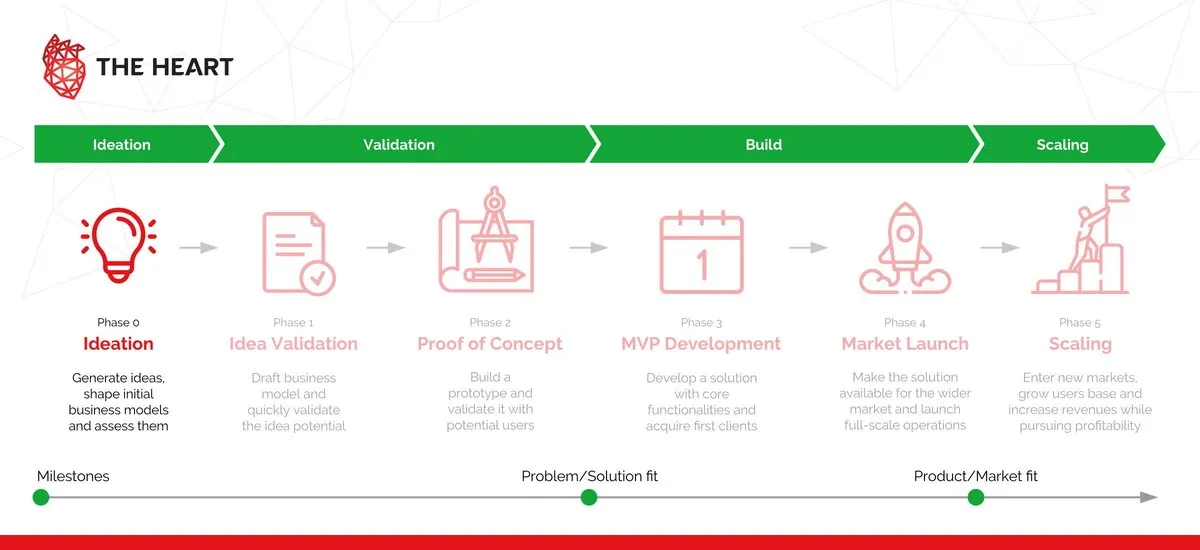
Ideation process is the very first stage of the whole venture-building process, where ideas are generated, before being assessed and selected for the validation phase.
The whole venture building process is illustrated below:
Principles of The Heart's authorial Idea Assessment Scoring System
- Using an objective scoring system
Each year, we meticulously examine more than 200 ideas, and to maintain objectivity, we have created a scoring system that enables us to swiftly evaluate and prioritize the ideas worth pursuing. While we acknowledge that it is impossible to definitively classify an idea as either good or bad, particularly at this early stage, we recognize that success largely hinges on execution and the ability to pivot. Nonetheless, by studying the characteristics of highly successful startups, we can identify certain parameters that increase the likelihood of selecting ideas with a higher potential for success.
- Use a phase-gate system
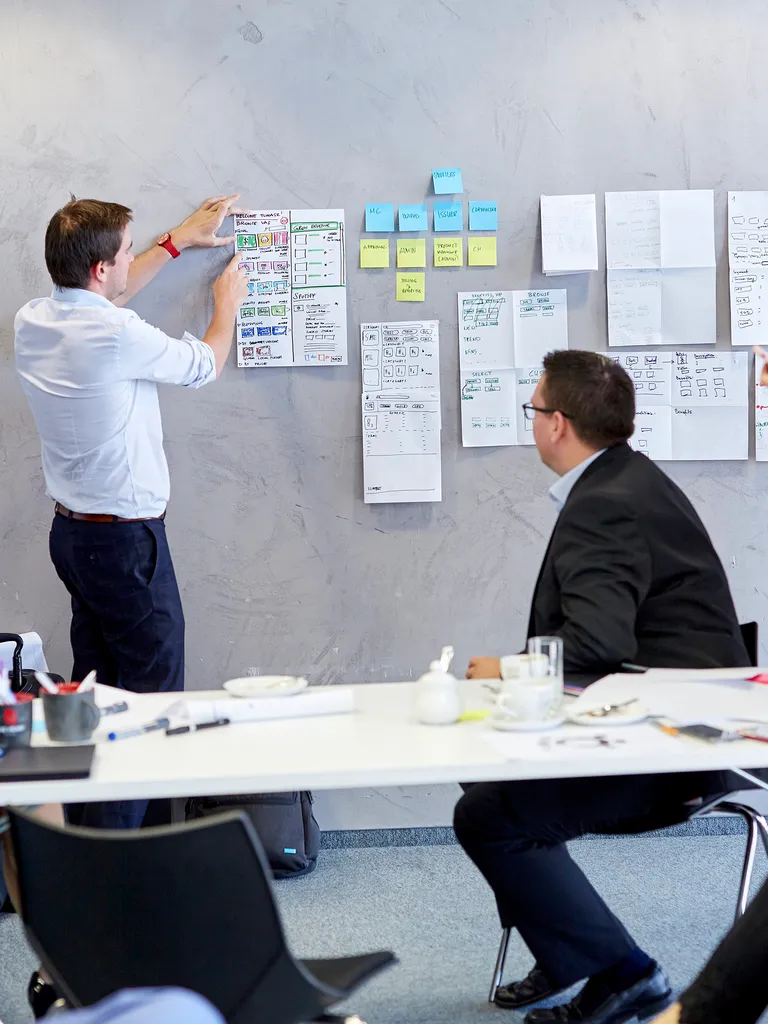
Since it's impractical to thoroughly assess every idea in the innovation process, we recommend conducting a phased analysis. As your confidence in an idea's potential grows with each step, you can allocate more time, eventually leading to the validation phase. Initially, the filters can be simple, such as group voting or eliminating ideas that clearly fall outside your scope. For instance, if your focus is on building Saas solutions for the construction industry, you should discard ideas like a marketplace for used office furniture.
- Define the business model behind the idea
Prior to evaluating the idea, it is crucial to establish the underlying business model to facilitate a comprehensive assessment. Utilizing a simple business model canvas or lean canvas would be fine for this purpose. It is advisable to refine the business model iteratively during the scoring process, as it allows you to identify and address any weaknesses that may arise, leading to necessary adjustments.
Idea assessment scoring tree
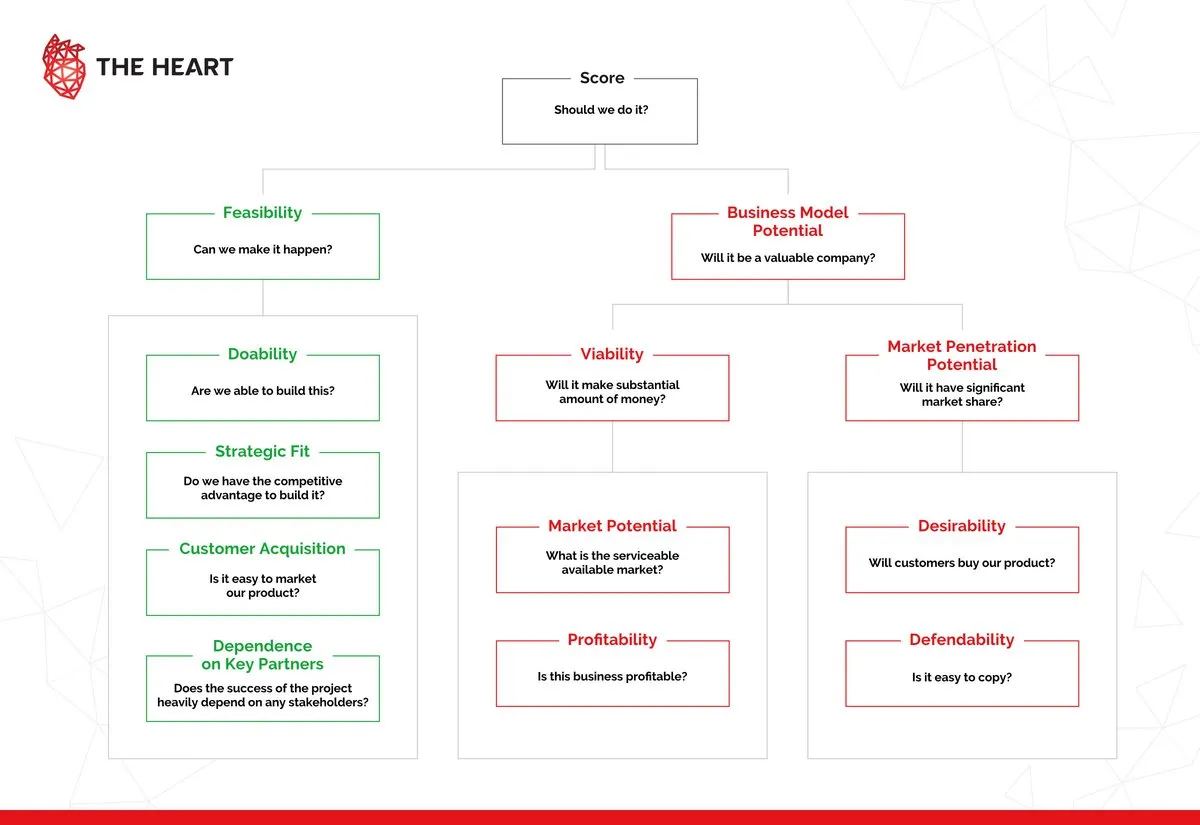
We consider a set of parameters grouped into two categories:
- the first assesses the feasibility of the idea,
- while the second evaluates the potential of the business model.
These categories are further divided into subparameters, and by assigning predefined weights to each subparameter, we derive an overall score that highlights the idea's strengths and weaknesses. This scoring system provides a comprehensive indication of the idea's potential.
12 questions you must answer
1. Feasibility. Can we make it happen?
Starting from the top, we start assessing the idea by looking at our chances of successfully building the company and making it fully operational. Some people call it “execution risk”. The detailed question that we are trying to answer here is:
- how likely are we to build this business model so that it is fully operational, the product is working, is available for purchase, and is distributed to customers?
The 4 parameters that we take into account to rate are the following:
1.1. Doability. Are you able to build this product?
Here we take into consideration things like:
- Technology Expertise - Do we know how to build the product?
- Product Development CAPEX - Will we be able to build MVP with average pre-seed/seed funding?
- Legal Feasibility - Is it legally feasible?
The easier it is to build for you, the better. To assess this, we are lucky to have brilliant engineers and lawyers within our group, that can give us an initial assessment after a brief consultation.
1.2. Strategic Fit. Do you have the competitive advantage to build it?
Here we take into consideration things like:
- Market Expertise - Do we know the market?
- Business Model Expertise - How easy for us is to build this business model?
- Synergies - Do we have any assets that we can leverage?
If you were a startup, not a venture builder or a corporate unit, this would be named Founder’s Fit. Before assessing this parameter, define your strategic areas and fields that you are good at - go through your assets, products, and project portfolio to see what you can take advantage of. If the idea is within your strategic focus and leverages your unique advantages, it is definitely a good sign.
1.3. Customer Acquisition. Is it easy to market your product?
This parameter holds significant importance, yet it is often overlooked by many startups. Some argue that distribution has more significance than the product itself.
Example
Microsoft Teams and Slack. Despite Slack receiving better user reviews, Microsoft capitalized on its Office software to distribute Teams, resulting in a user base of 270 million, while Slack has only amassed 20 million users.
Another guiding principle we follow is the preference for building something that a small number of people desire in large quantities, rather than something that a large number of people desire in small quantities. Targeting highly fragmented markets, such as small businesses or individual customers, often necessitates substantial marketing investments to achieve the desired scale. Consequently, we prioritize B2B businesses for corporate clients, as reaching the break-even point becomes feasible without relying on capturing thousands of customers upfront. Additionally, exploring synergies with existing products in your portfolio can significantly improve the scoring, particularly if you can leverage pre-existing distribution channels.
1.4. Dependence on Key Partners. Does the success of the project heavily depend on any stakeholders?
Almost every business model requires partners - they could be technology vendors, distributors, or service providers. If there are plenty of partners to choose from in each category and a single one does not have influence, then you do not have to worry.
The problem is when the fate of the project depends on one partner that may change strategy in the future.
Example
If your solution is based on ChatGPT and cannot provide its core value without it, such a strategy may be very risky. What if OpenAI decided to drastically increase their pricing or the EU decided to ban using their algorithm? Hence, an ideal scenario would involve having numerous options or alternatives available, almost resembling a commodity. Payment gateways serve as a fitting example in this regard.
2. Business Model Potential. Will it be a valuable company?
The second main parameter rates the ability of a defined business model to generate money and therefore how valuable could it be. The detailed question that we are trying to answer here is:
- how likely is this business model to reach [your expected return], while it is fully operational?
Mathematically, this parameter can be represented as the product of the market value and the expected market share. Similar to the Feasibility rating, we also consider four parameters, but this time they are grouped into two categories: Viability and Market Penetration Potential.
2.1. Viability. Will it make a substantial amount of money?
Mathematically, this parameter would be represented as volume multiplied by unit margin. Therefore, we have to take into account the target Market Potential and Profitability.
2.1.1. Market Potential. Is the market attractive?
Here we take into consideration things like:
- Market Size - What is the SAM (Serviceable Available Market)? How many people/companies have the problem that we are trying to solve X how much would they be willing to pay to solve it?
- Market Growth - How fast is the market growing?
To determine the attractiveness of the market, we must consider not only its current size but also its growth rate. In some cases, acquiring this information may be straightforward, as numerous market research papers are readily available online, providing accurate data for calculating these metrics.
However, if such data is not accessible, estimation should be conducted using either a top-down or bottom-up approach. This involves utilizing available data or making informed assumptions to gauge the market's potential. Obviously, the higher the market size the better but remember to avoid excessive optimism.
2.1.2. Profitability. Is this business profitable?
Here we take into consideration things like:
- Unit Economics - Will the business be profitable, taking into account ARPC (average revenue per customer) and variable costs like CAC, intermediaries, production, and service cost?
- Economics of Scale - Does the EBITDA margin grow exponentially with volume?
To assess this, you can create a spreadsheet and calculate the estimated revenue and costs per unit sold. However, usually, you don’t know the exact value of each number and it may be time-consuming to research them.
The easiest way to assess it would be by looking at the business model, whose type may accurately determine the margin level. For example, digital-based subscription services, marketplaces, and transactional businesses would have higher margins compared to hardware technology or e-commerce.
2.2. Market Penetration Potential. Will it have a significant market share?
This parameter defines the expected market share of our business model. In other words, it suggests how many customer out of all we target are likely to buy our product or service. Also, it is important to acknowledge the risk of other companies that may enter the competition and take our market share in the future.
2.2.1. Desirability. Will customers buy our product?
Here we take into consideration things like:
- Problem Significance - How severe is the pain point it solves or how strong is the customer need?
- Current Alternative - Is our product/service better than other products or services that are alternatives for customers to solve given needs?
- Competition - Are there any companies in Poland that provide similar products/services and will be our direct competition?
- Foreign Competition - Is the foreign market already congested?
- Scalability - Are we able to sell our product abroad?
This parameter can be one of the most intricate aspects to consider. Obtaining valid answers typically requires conducting tests with potential clients, but this can be time-consuming at such an early stage. To address this, we recommend listing all alternative solutions that aim to solve the same problem in different ways, along with any existing competitive solutions. These alternatives should be compared in terms of price, functionality, and user experience (UX). It's crucial to be mindful of the lock-in effect, as users' behaviors and habits are challenging to change.
The presence of competitors in the market does not necessarily indicate it's too late to enter. In fact, it may be a positive sign. Conversely, the absence of competitors often suggests a lack of demand for the product. However, it's important to ensure that your business has the right business moat (competitive advantage) and unique selling proposition (USP).
Furthermore, analyzing the potential for geographical expansion from the outset is vital, as our ventures typically aim to scale into other markets. Ideally, your product or service should possess significant advantages over alternatives and competitors, have low switching costs for users, exhibit potential for international scaling, and operate within a global market that is not overly congested.
2.2.2. Defendability. Is it easy to copy?
Lastly, it is crucial to avoid launching an idea that can be easily replicated, as this would result in a possible loss of market share. Merely having a first-mover advantage may not provide sufficient protection.
Ideally, the best ideas should incorporate a technology stack that is prohibitively expensive for others to develop or leverage an ecosystem of partners and a client base (especially in the case of marketplaces due to network effect) that is essential and cannot be established within a short timeframe. As Peter Thiel suggests, all companies should strive to build a monopoly, wherein they establish a unique position in the market that is challenging for competitors to replicate.
Useful tips for assessing ideas
To effectively select the best startup ideas, it is crucial to consider three additional filters:
- The Unsexy Filter
This filter relates to fields or industries that may initially appear unappealing or boring, deterring many from working on them. It's important to recognize that the initial excitement surrounding an idea will fade, and the day-to-day realities of running a startup will become more significant than the idea itself. Therefore, it's necessary to evaluate ideas objectively, beyond their surface-level attractiveness.
- The Schlep Filter
The Schlep Filter refers to ideas that may seem difficult or uncomfortable due to perceived challenges or complexities. For instance, prior to 2010, the e-commerce industry faced a well-known problem with online payments. However, starting a startup in this area, which required collaboration with financial institutions and obtaining licenses, appeared daunting. Stripe, however, recognized the opportunity and tackled this problem, subsequently becoming one of the most popular payment gateways. It is essential to question whether perceived difficulties are genuine barriers or illusions.
- Tarpit Ideas Filter
Tarpit ideas are those that attract widespread attention due to an evident problem and a seemingly straightforward solution. However, executing the solution turns out to be much more challenging than anticipated. For instance, consider an application designed for managing hanging out with friends. While there is a need for such a solution, numerous attempts have failed to succeed. It is crucial to be cautious of ideas that may seem simple on the surface but entail hidden complexities and hurdles.
How can partnering with Corporate Venture Builder boost idea assessment?
A professional partner specialized in innovation management is a valuable asset for the corporate innovation unit regarding idea generation. The same goes for the idea assessment process.
Corporate Venture Builder can help you select the best ideas and effectively allocate your investments thanks to:
- Evaluation Frameworks - The venture builder can develop evaluation frameworks or scoring systems to assess and compare different business ideas, such as the one described above.
- Different Perspective and Objectivity - Tailor-made reports covering a selected market with shortlist of interesting solutions, technologies, startups, business models, or relevant trends
- Technical Expertise - Access to resources like software houses or legal offices can provide valuable insights and initial assessments regarding the doability of an idea.
If you want to learn more about Idea Assessment, check the links below:
with The Heart?
Join us and be part of a team that's shaping the future through innovation, creativity, and bold ventures. Ready to make your mark?